I'm giving a lunchtime talk at GSA in the Reid Gallery next week talking about my residency in March at Inshriach Bothy. Here's the link.
http://www.gsa.ac.uk/life/gsa-events/events/l/lunchtime-talk-lesley-punton/
Showing posts with label solitude. Show all posts
Showing posts with label solitude. Show all posts
Wednesday, 10 September 2014


Friday, 11 April 2014
stilled life with moving trees - a bothy project residency at Inshriach
 |
| Inshriach Bothy |
 |
| view from the porch |
I arrived during a week of gales. The Cairngorms are windy at the best of times, yet I’m accustomed to being on the brittle granite plateau where the combination of altitude and the persistence of the wind creates a sub arctic landscape, a place where plants hug the land tightly. However because of the wind’s excessive force and unpredictable cloud level, the snow covered plateau became essentially out of bounds.
 |
| arrival at the bothy |
The trees became the most dominant part of my experience. Sat in an elevated hollow, surrounded by a wood of silver birch interspersed with dwarf juniper, the bothy is quite protected and sheltered. Unless you know it’s there, or happen to walk close along the trail, you’d probably be oblivious to its very existence. I spent a good deal of time watching the trees and their movement, and listening to their sound, mixed in with the white noise of the River Spey which flowed in spate and flood nearby.
 |
| birch, pine, heather, juniper |
stilled life with moving trees (video documentation of my residency)
I came with a loose idea of some work I could make, thinking that a plan would be wise, but soon abandoned it, and learned to leave preconceived notions well alone, and simply be with the place. Nan Shepherd’s text, the living mountain guided me well in this sense, (and, struck by it’s notable absence on the bothy’s bookshelves, I popped out to Aviemore to buy a copy to leave as a gift).
The work didn’t come, but the time to think, and reassess aspects of my life and practice did, and I felt the repercussions of the trip perhaps more clearly once I returned home. I needed the time away, the space to be undisturbed by modern distractions such as the compulsion to check email. Technology has become particularly invasive and guilty of creating a syncopated rhythm to lifes that can be led more simply.
As someone who has always loved solitude, I don’t think I’d appreciated how difficult complete solitude is however (thank goodness for a battery powered radio playing Radio 4!). Inshriach can be a quiet place, but on reading the bothy book, it’s clear that for most people, residencies here are anything but solitary, and spur on collaboration.
 |
| An Lochan Uaine through Caledonian Pine |
 |
| from the summit shelter cairn of Meall a' Bhuachaille |
 |
| the Cairngorms and Rothiemurchus |
On my last morning, I wake up to snow, the landscape again transformed. After a hot outdoor shower, with the snow still falling, I pack my things, then make the couple of trips back to the car parked almost a mile down the trail, food supplies diminished, and my load lighter than when I arrived. The weight of the city had also been lifted, and I'm reminded (if I ever really need such a thing) that part of me needs to be in the wild. I anticipate being reunited with my 3 year old son, so the departure isn't unwelcome in the way it would have been years ago, but the bothy, a perfectly formed small space packed with the essentials for good living, sends me on my way, nourished, and replete.
 |
| the bothy at dusk |
 |
| nautical twilight |
 |
| book found in the bothy library |
 |
| a sun dog through the birch trees |
 |
| the view North |
With thanks to Walter Micklethwait and everyone at Inshriach, and to Bobby Niven of The Bothy Project
all images L Punton, 2014
all images L Punton, 2014
Tuesday, 11 March 2014
a week long residency at Inshriach Bothy
I'm just about to set off on a week long residency at The Bothy Project's first bothy at Inshriach. A week to think, walk, and make in isolation, solitude and peace.
see http://www.thebothyproject.org/ for more info.
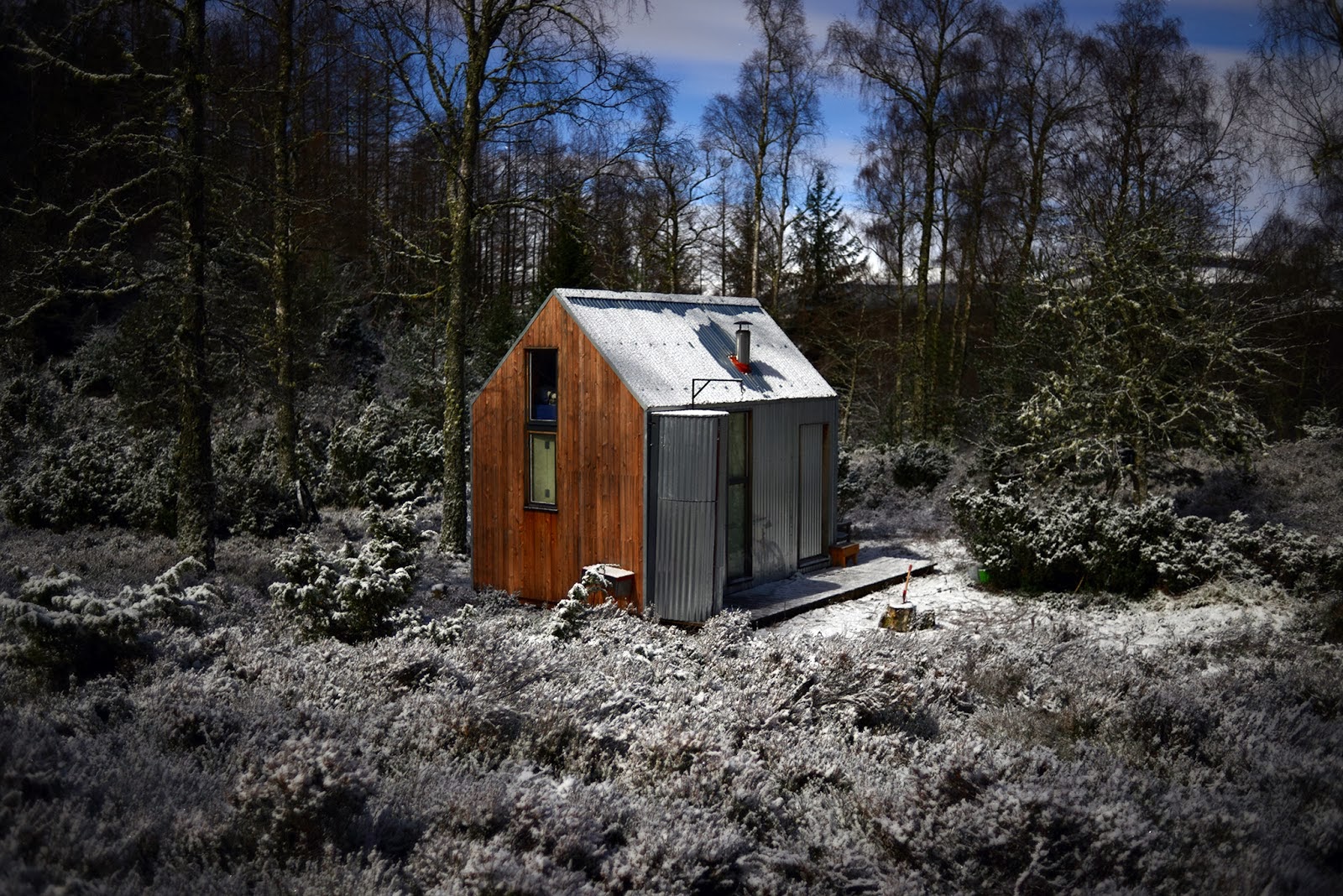 |
| exterior in moonlight (photo Johnny Barrington) |
 |
| interior (photo Luke Allan) |
see http://www.thebothyproject.org/ for more info.
Wednesday, 27 October 2010
fond remembrance of places
Thinking of Ravilious, I'm reminded of a trip I made to Barra to visit a close friend who was staying in the croft house that was owned by Ravilious' old friend, the designer and artist Peggy Angus. Ravilious didn't visit Barra as far as I'm aware, but made much work at Peggy's other house "Furlongs" on the South Downs.
I think familiar, well loved places are of great importance to a great many artists, particularly those concerned with landscape, and it seems that Furlongs was one such place for Ravilious.
Back in Barra, we climbed the island's highest hill, the relatively small Heaval, enjoying the view around the island down to Castlebay, a view presumably familiar to Peggy Angus and to those that would have
regularly come to visit.
 |
| Eric Ravilious - Furlongs |
 |
| exterior of Furlongs |
I'd never been to Barra before. We arrived at Peggy's house at twilight off the surprisingly long ferry journey from Oban, cycling along the single track road just being able to make out the house in the fading light, to find my friend in a magically evocative place lit by candles and the light from a log fire, cooking on a portable gas stove, and surrounded by years of accumulated objects of interest gathered by Peggy. It's a primitive space (Jim and I slept on an extremely smoky platform above the "kitchen" area), and not one for those looking for luxury (indeed, it's not much more luxurious than many a bothy) but it's spartan qualities are made up for with an abundance of character. The house is just as she left it before she died, and is still used by the family for holidays (my friend is close to the family). Unfortunately I didn't take any decent pictures of the house, but I do understand how places become closely linked with the creation of artworks, and have had similar experiences with places I've become intimately acquainted with over the years in Scotland.
There's a house in the West coast that, due to the generosity of an aunt and uncle, I was able to regularly visit throughout the 1990's and early 2000's, and where I made much of my first photographic work. In part, it's joys stemmed from a simple escape from the city. The place itself, with no road access - the easiest way to reach it was by rowing across the loch - a place where time and the pace of life seemed to slow down, where there was no TV, telephone, (and latterly, mobile reception) encouraged a reflectiveness that nourished my creativity. I visited usually around three times per year, most often bringing friends, but also sometimes visited alone. This was probably the only place where I've gone a whole week without uttering a word to another human and experienced real solitude, bar hearing a voice on the radio.
 |
| L Punton, where deer sleep, silver gelatin print, 1996 |
Back in Barra, we climbed the island's highest hill, the relatively small Heaval, enjoying the view around the island down to Castlebay, a view presumably familiar to Peggy Angus and to those that would have
regularly come to visit.
 |
| view from the summit of Heaval, Barra |
Saturday, 15 May 2010
the living mountain
I finished reading Nan Sherperd's slim volume 'The Living Mountain' today. It's one of those books which you want to savour, and at a mere 84 pages, you know will be over before you really want it to be. Sensing it's condensed riches, I've read it really rather slowly over the last month.
Her only non fiction book, it is a meditation on the Cairngorm mountains and of the experience of walking and getting to know it's peaks, corries and the plateau. It's an amazingly well observed, perceptive and thoughtful consideration of the ontological aspects of spending prolonged periods in wild spaces. This work was written in the 1940's (though not published until much later by Shepherd in 1977 when she was an old woman) and was, for it's time, a prescient book that still resonates today. It stands apart from much mountain literature written by men (although WH Murray would seem to be a kindred spirit) in the way that it explores the nuances of the whole experience of being in the Cairngorms rather than on simply conquering peaks. As a woman walking (often solitarily), bivvying, and camping on the tops for days on end at a time when hillwalking wasn't the mainstream pastime that it is today, Shepherd must have seemed to be a bit of a radical adventurer. Having her own income (she was a lecturer in English at the Aberdeen College of Education after graduation from Aberdeen University until retirement), her working life echoes the sentiments in Virginia Woolf's 'A Room of One's Own'. She has often been compared to Lewis Grassic Gibbon in terms of the writing style and content in her fiction, though hers is a more emancipatory vision of modern women finding a way out of the drudgery of unliberated life. Her circumstances did permit her to be able to spend many thousands of hours exploring and deepening her knowledge of the Cairngorms which she grew to love so much.
I suspect my own relative familiarity (I read some of it with a 1:25000 OS Explorer map at my side recalling my personal experiences of the locations) with the plateau extended my own enjoyment of the book immensely, knowing how an understanding of the Cairngorms doesn't usually reveal itself upon ones first visit there, unlike the more spectacular western peaks in Scotland. From afar, the Cairngorms actually look a little dull, and their mass is difficult to appreciate. Walking on them on a fine day, they seem benign, and the ground below your feet stretches out for long miles so that the drama of a vertiginous drop doesn't often surprise. However, repeated visits seem to offer up a different appreciation where the vast distances one is required to walk allow for an experience where one begins to make connections with a bodily connection to place, where one feels a greater sense of 'being' in relation to the land.

Of course, one of the most defining characteristic of the Cairngorms is the extreme severity of the climate which it experiences. It is the only place in the UK where it's climate is considered sub-arctic, and the types of flora and fauna present testify to this. Mists can come in unexpectedly and the uniformly high altutide of the land make navigation particularly difficult. In winter, judging distances in whiteout conditions is treacherous and many have died over the years through navigational error - sometimes remarkably close to safety.
Shepherd acknowledges the various terrors, but mostly joys, of this remarkable landscape. In her observations, through chapters headed The Plateau, The Recesses, The Group, Water, Frost and Snow, Air and Light, Life: The Plants, Life: Birds Animals Insects, Life: Man, Sleep, The Senses, & Being, she breaks down and analyses the constituent parts of the mountain experience in a way where the interconnectedness of sensation are made more lucid. She notices small details and enlivens our appreciation of natural phenomena with botanical and geological precision.

Sometimes a smooth portion of stream is covered with a thin coat of ice that, not quite meeting in the middle, shows the level of the water several inches below; since the freezing began, the water upstream has frozen and less water is flowing.
and
At one point (I have heard of it nowhere else) near the exit of a loch, the peculiar motion of the current among ice floes has woven the thousands of floating pine needles into compacted balls, so intricately intertwined that their symmetrical shape is permanently retained. They can be lifted out of the water and kept for years, a botanical puzzle to those who have not been told the secret of their formation.

In Sleep, she contrasts the experience of physically traversing the land with that of the quiet stillness found through sleeping on the high plateau and experiencing awakening in such a place.
I can teach my body many skills by which to learn the nature of the mountain. One of the most compelling is quiescence. No one knows the mountain completely who has not slept on it. As one slips over into sleep, the mind grows limpid; the body melts; perception alone remains. One neither thinks, nor desires, nor remembers, but dwells in pure initimacy with the tangible world.
Shepherd's approach, desipte the specifics of it's Cairngorm location, isn't parochial, but could be seen to reflect the work of Maurice Merlau-Ponty and the study of phenomenology, and shares much with Zen Buddhism in the appreciation of being in inanimate things.
She says, in the penultimate chapter, Senses, when trying to explain the fascination and love for high places:
It is, as with all creation, matter impregnated with mind: but the resultant issue is a living spirit, a glow in the consciousness, that perishes when the glow is dead. It is something snatched from non-being, that shadow which creeps in on us continuously and can be held off by continuous creative act. So, simply to look on anything, such as a mountain, with the love that penetrates to it's essesnce, is to widen the domain of being in the vastness of non-being. Man has no other reason for his existence.
..and in the final chapter Being:
Here then, may be lived a life so pure, so untouched by any mode of apprehension but their own, that the body may be said to think. Each sense heightened to its most exquisite awareness, is in itself total experience. This is the innocence we have lost, living in one sense at a time to live all the way through.
and..
Walking thus, hour after hour, the senses keyed, one walks the flesh transparent. But no metaphor, transparent, or light as air, is adequate. The body is not made negligible but paramount.

Sunday, 2 May 2010
the solitude trilogy : part 1
I've been listening to one of Glenn Gould's CBC radio broadcasts that he made in in the 1967 entitled "the idea of North". It's a collage of various people who live in or have a relationship with the North, and in this instance, the North of Gould's native Canada. It can be quite difficult to follow or hear as he's layered some of the voices of the 5 people interviewed over one another so that there's a fading ebb and flow of text - presumably the creativity of Glenn Gould "the pianist" was something that he wasn't willing to sacrifice for the sake of documentary clarity, and here too Gould was trying to create an audio work, rather than simply a piece of public broadcasting. Radio as art as it were. In fact, he often described his radio works as contrapuntal, borrowing the term from music and characteristic of the Bach repertoire he's most widely known for. He made these radio broadcasts after his retirement from the international recital/concert citcuit.
The piece concentrates on how people view and interact with the North as both a space and an idea, and crucially, isn't simply a romantic treatise on solitude, although of course, it acknowledges romanticism as a spur to movements Northwards. Gould says the work "sought to examine the effects of solitude and isolation upon those who have lived in the Arctic or sub-Arctic".
I still have the other two pieces to listen to, but have transcribed some of the quotes from the piece I found most interesting.
I've long been intrigued by that incredible tapestry of tundra and taiga which constitutes the Arctic and Subarctic of our country. I've read about it, written about it and even pulled up my parka once and gone there; yet, like all but a very few Canadians, I've had no real experience of the North. I've remained, of necessity, an outsider. And the North has remained for me a convenient place to dream about, spin tall tales about, and in the end, avoid. – Glenn Gould during the introduction to the idea of North.

..three of the various voices from the piece:
You're excluding the rest of the world that will never understand, and you've made your own world with these other people, and probably you'll never know, and what nobody else will know is whether you're kidding yourself or not. Have you really made your peace with these other people or, or have you made a peace because the only alternative is a kind of crack-up?
I was in many repsects solitary, but in a strange way the North has made me more, sort of, gregarious, 'cos the North does show you exactly how much you rely on your fellow man, what the sense of community means. The sense of community in the North, unlike in the South, is a matter of life and death. The thing about the North of course, in personal terms is that in the North you feel that ..it's so big, it's so vast, it's so immense, it cares so little and, and this sort of diminishes you, and then you think "my god, I am here, I've got here, I live here, I live, I breathe, I walk, I laugh, I have companions."
I found that the wide open spaces concept isn't quite what it's cracked up to be. I felt cooped-in in the wide open spaces because I was so afraid to get lost, that the environment around me, while being vast in the physical sense - one could see theoretically for a thousand miles, it was as nothing was in the way to break your view - it was surrounded on each side by dangers, dangers for instance of getting lost, that this was, to me, the biggest danger of all.
Subscribe to:
Posts (Atom)

