Showing posts with label australia. Show all posts
Showing posts with label australia. Show all posts
Monday, 31 August 2015
visual/bind
The first edition of visual/bind which includes David Watson't essay on my work "walking as knowing"is now online at http://visualbind.org/ Visual/bind is a new journal from Australia where artists write about other artists' practices.


Thursday, 6 September 2012
swimming home
David Watson and I are having an ongoing dialogue regarding how walking and journeying affect our individual creative practices in relation to a future project we're working on. Here he is 'swimming home' up the Parramatta River in Sydney, Australia.
Thursday, 20 October 2011
burning mountain part 2
I mentioned in an earlier blog post that during my recent trip to Australia, I was hoping to visit a place known colloquially as "burning mountain". Well, I did manage to get there, and indeed, to climb the mountain. On Mount Wingen, (it's official name) there's an underground coal seam that has been burning for around 6000 years and which currently reaches the surface almost at the very summit of the hill, a fortunate occurrence it seems. Long thought to be a volcano, it's only relatively recently that it's existence as the oldest naturally burning coal seam on earth has been confirmed.
The term mountain is, to my Munro climbing eyes, a bit of a misnomer as the summit can be reached by a well constructed pathway in about an hour. As you reach the summit field, you reach a raised deck designed to keep you off of the friable, brittle earth. There's no smoke dramatically billowing from holes; only a gentle warmth in the air. There's a strangely pleasant and mild smell of sulphur that reminds me of the glass jar filled cabinets of the chemistry lab of my school days, and an awareness that the ground resembles the burnt out embers of a coal fire. Bird song, exotic to my Northern European ears, resounds all around.
Once you ignore the warnings and leave the safety of the deck, the true nature of the hill begins to reveal itself. The smell of sulphur stays the same and you become quite acclimatised to it, but you gradually notice more that the ground is not quite the same as anywhere else you've ever been. Cracks and chasms open up where the seam has riven open the ground during the burning head's passage years earlier. The sharp, brittle, almost hollow nature of the ground is confirmed as your feet crunch upon the pale burnt out embers as you pass slowly over them. Then you begin to really sense heat, more than just mere warmth. A heat haze rises from patches of the ground, sometimes only very faintly. There are kangaroo droppings where the ground is pleasantly warm, the animals clearly using the hill top to find solace during the night. And finally, as you've wandered the summit field, you edge over to one side to discover the burning head of the seam and are met by a fierce heat. Not so hot that you can't stand upon it, but hot enough that you wonder whether the soles of your shoes will melt a little, and that radiates an intense heat towards your face that quickly becomes oppressive. I film the experience with my camera, and the heat at this climax causes my lens to flare in bursts. I look down at my footprints and think of Armstrong and Aldrin's on the lunar surface, the texture seeming so oddly similar.
Of course, most will also have noticed on the way up that the ground moves gradually from being fertile and populated by vegetation, to a forest floor where not much grows, the burning head having passed below in the past. Those more observant and educated in such things may recognise a shift in the types of gum trees that grow along the way from eucalyptus that thrives in temperate areas, to those more commonly seen on the fringes of the outback and capable of withstanding greater heat and aridity.
(note, detail of heat haze in the above video is more clearly visible when viewed on Vimeo)
Monday, 29 August 2011
dark cloud constellations : the emu and coalsack nebula
 |
| our campsite in the bush near Gilgandra |
 |
| the sky in the southern hemisphere photographed near Gilgandra, NSW. (click on the image to enlarge enough to view) |
 |
| the "emu" (image by D. Smith) |
Back to solid visible objects, as you drive along the road to Coonabarabran, you pass various models of the planets in our solar system with the 37m dome of Sliding Spring Observatory representing the sun.
 |
| "Jupiter" |
 |
| Jupiter, west of Coonabarabran |
 |
| Neptune, in Gunnedah |
(See also here for a post on the Guugu Yimithirr people of Northern Queensland).
Sunday, 28 August 2011

Saturday, 27 August 2011
fruit bats
A short video I made in the botanical gardens in Sydney of the extraordinary colony of fruit bats. Apparently there are so many of them they are beginning to damage the trees. As the bats are a protected species, the gardeners have been given special dispensation to try to reduce/control their numbers.
Sunday, 21 August 2011
burning mountain part 1
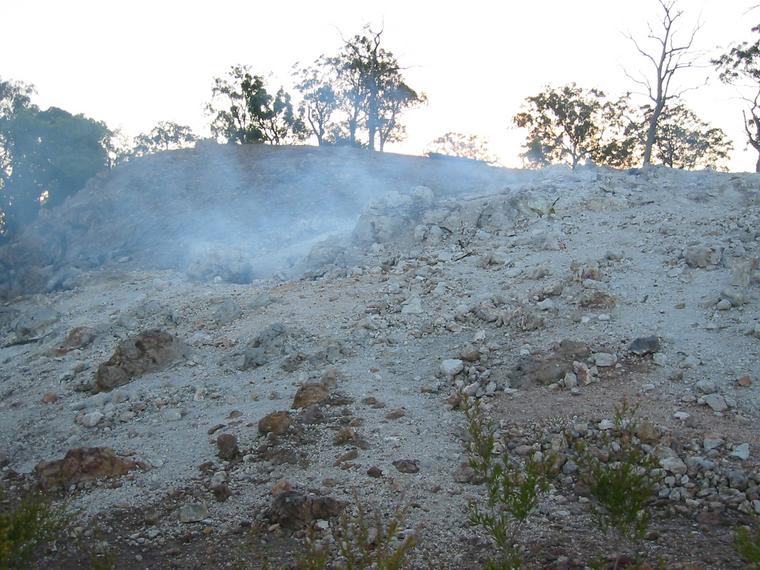 |
| the coal seam at the top of Burning Mountain (Mt Wingen) |
Looking into places to visit on our road trip in Australia (we collect our camper van tomorrow), I'm attracted to a place called Burning Mountain. I'm told "you won't see much there", or more commonly "never heard of it" from various locals here in Sydney, but to me, it looks fascinating. Burning Mountain, or to give it it's proper name, Mount Wingen, was thought to be a volcano, but it's now known to be an underground seam of coal that's thought to have been burning for almost 6000 years. The plant life en route to the summit has suffered, with little growing on the forest floor. The burning head of the seam can be seen and the fire pours out sulphurous gas and smoke.
Subscribe to:
Posts (Atom)

