Showing posts with label photography. Show all posts
Thursday, 28 August 2014
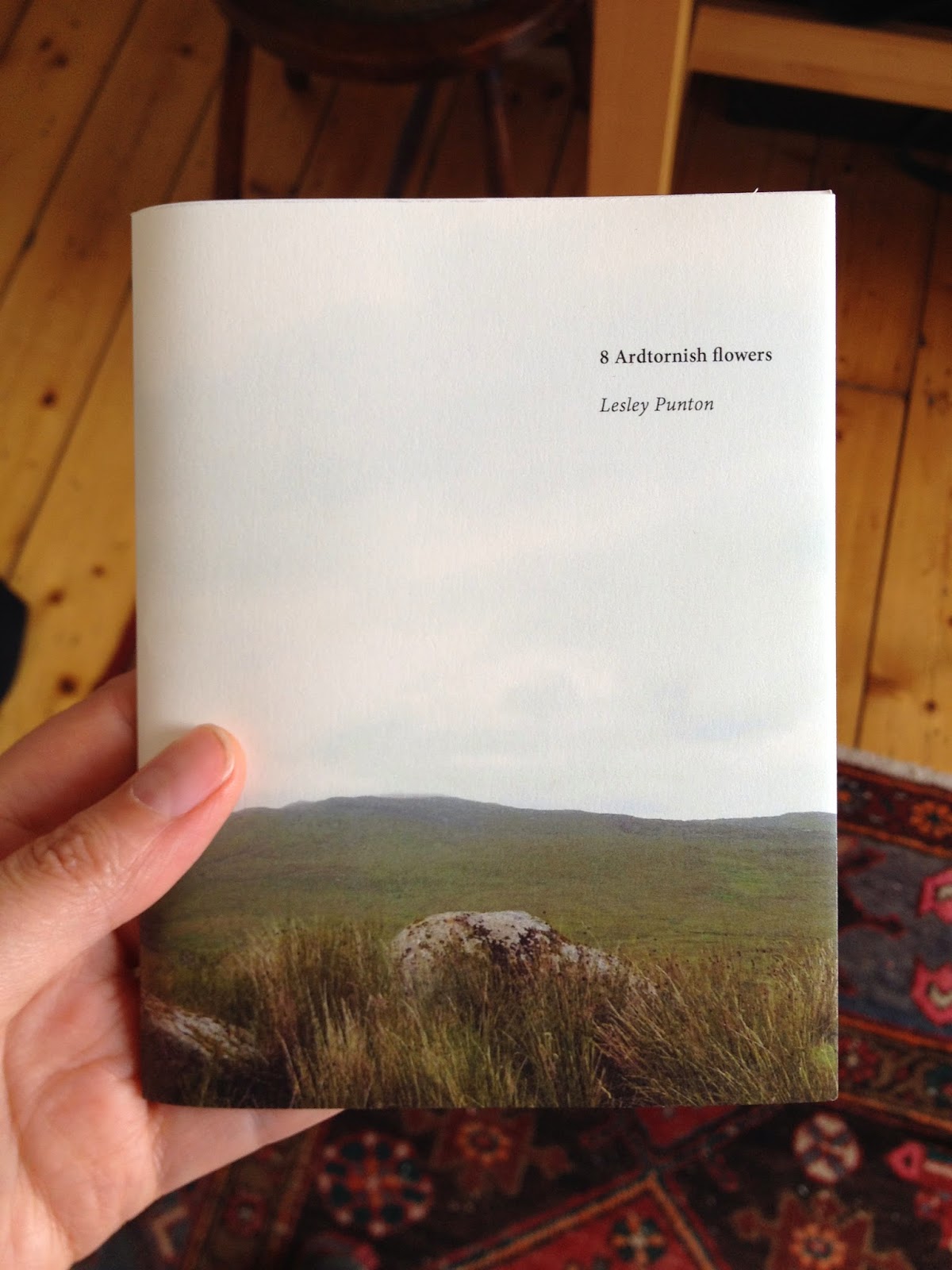
8 Ardtornish flowers
Unusually for me, this small bookwork was made more as a reminder of a lovely holiday with some lovely people, rather than being a "serious" part of my practice. I taught the kids (and some of the adults) in my extended family how to make cyanotypes "in the field," exposing them to the Scottish summer sunshine and washing/processing in the open. These are a few of a series of postcards I made once the kids went off to do other things.
Monday, 28 July 2014
ardtornish cyanotypes
Thursday, 26 June 2014
Tuesday, 1 October 2013
mountains without end
My new book, "Lesley Punton - mountains without end" has come back from the printers. Here's a preview of a few spreads from the book. Sandie Macrae, Director of ROOM, and ROOMBOOKS - the gallery's publishing arm, has written the foreword. Thomas A Clark has written an essay on my practice entitled On Looking at Mountains, as has Dr David Watson in his piece Walking as Knowing, and Alec Finlay has contributed a poem Pataphysical Cuillin. Some of my own writings, fragments of which appear within this blog, are included in texts at the end that collectively come under the heading notebook.
ISBN 978-0-9549915-6-2
edition of 1000
64pp, full colour, soft-back, burst bound, lithographically printed, 246x189mm
Contributors (text) Thomas A Clark (UK), Dr David Watson (Australia), Alec Finlay (UK), Sandie Macrae (UK) & Lesley Punton (UK)
Published by ROOMBOOKS
Date : September 2013
£10 + p&p available directly from my website and at Aye Aye Books, Centre for Contemporary Art, Glasgow.
Monday, 18 June 2012
Tuesday, 24 April 2012
back to the things themselves, part 2
Installation views of Back to the things themselves, Lesley Punton & Judy Spark, at the Briggait 20 April - 7 May, Glasgow International Festival, 2012
![]() |
| photo credits : L Punton |
Labels:
drawing,
exhibition,
graphite,
installation,
landscape,
light + dark,
mountains,
my work,
painting,
photography,
Robinson Crusoe,
scotland,
silverpoint,
sound,
text,
The Magic Mountain
Wednesday, 18 April 2012
Saturday, 7 April 2012
back to the things themselves, part 1
Here's the reason this blog has been a bit quiet lately..
from the GI website:
"Lesley Punton and Judy Spark share a concern in their attempts to bridge a certain sort of gap; that of the difference between the physical experience of specific varieties of ‘natural’ phenomena or places, and their articulation in human terms. Both feel the impossibility attached to this problem, but nonetheless remain dedicated to its resolution through the making of art. For these two artists, the making of an artwork is a process of interrogating lived experience and it is the language used to express this search, which is also a quest for other varieties of understanding, alternative ways of knowing the world. The question of whether such alternative interpretations are subjective or in some way universal is inherent to the work.
The processes of Punton and Spark sustain common patterns; periods of concentrated engagement with objects and places of interest, an awareness during such engagement, of duration, of breathing, of scale, and working methods which mirror these physical experiences; an almost meditative approach to drawing for example. The results stand as evidence of the inquiry, the process itself is what is important. The bodily experience of phenomena is reflected in the consideration of how, and for how long, the viewer physically encounters the work, which is ‘quiet’ and aims to draw the viewer into a contemplative ‘space’ in which they might imagine, or consider, their own process of engagement with ‘the things themselves.’
Having recognised the similarities between their working practices, the two artists have become begun to pay close attention to their contrasting approaches to the pursuit of an idea; Punton’s is deeply experiential, entirely dependent upon the measured contact of her feet with the ground of the remote environments she craves. Spark however, despite a natural bent towards phenomenological thinking and certain Eastern approaches to the natural world, feels unable to completely suspend her embeddedness within technologically bound western culture, for her a revised understanding of one, can only impact the other.
From the dialogue generated by these commonalities of practice, as well as their disjuncture, the artists intend to probe the gaps between experience, whether natural or technological, and its articulation, with the hope of uncovering the fertile ground of potential new understandings. The resulting work will take the form of drawings, photography and recorded sound."
Monday, 30 January 2012
Revisiting An Caisteal part 2.
In November, I climbed An Caisteal, a hill I’ve been up many
times, in order to make another summit photograph. Having realised that I’d
often inadvertently made the same image upon reaching the cairn, I’ve subsequently
decided to consciously record the various conditions of weather and light from
this viewpoint whenever I revisited the mountain.
Nevertheless, despite the
difficult conditions, the pleasure of being out in wide open space, of reaching
the top with relative ease despite concerns about how hill-fit I might
otherwise be, even of managing despite
such difficult, and lets face it, unpleasant
conditions, I was still so happy to be out on the hill, to be somewhere that I
felt I belonged. It seems a cliché, but I felt that I was home, and that I was
doing something so intrinsically core and central to my being that this return
to An Caisteal nourished me in ways not many other things are capable of. The
photograph is a disappointment, though somehow I don’t really mind.
Having a small child, my hill-walking opportunities are
fewer than they used to be and I hadn’t climbed a Munro for quite some time. Many
of the feelings I’ve often experienced
during such walks consequently came flooding back. The greatest sense was of freedom, and a relief to be away
from cities, noise, distractions, and to be entirely at one with the effort of
ascending the boggy, tussocky grass on the lower slopes which admittedly are
always a bit of a trudge on this hill. The smell of the damp earth was
strangely comforting. Slowly and carefully pacing myself, finding a rhythm in
my step, walking becomes effortless. Thoughts hone into the here and now. I
enjoy the silence. In fact, I need the silence. Work pressures dissipate. The
land opens out to show something more enduring, more stoic.
Familiarity is a fine thing sometimes, for without the
hindrance of a map (well, of the need to actually use it anyway), close
knowledge of the mountain’s geography enabled me to persevere through the early
trudge to reach the wonderful long ridge of Twistin’ Hill, the best part of the
mountain. This takes you, eventually, to the rocky boulders and “castle” that
gives a little scramble before the final cairn is reached soon after.
As seen in my previous post, I’ve climbed this hill in
beautiful winter conditions many times. It’s not a difficult hill and is
climbed usually in around 5 hours, up and down. Determined to make the most of
a free day and to make a new photograph regardless of the weather, we found
ourselves (Jim & me) however, climbing on a day with 80mph gusts of wind
and with the summit engulfed in cloud. These were by far the most
difficult conditions I’d been up on this hill in. Had I not had the desire to
make an image from the top, I’d have been tempted to return once we reached a
point where the wind on the narrows of the exposed summit ridge meant I had to crawl
on hands and knees to be sure I wasn’t blown off in a sudden and unpredictable
gust. Miraculously, the rock of the scrambling portions provided some shelter
and allowed the “trickier” moves to be made in relative safety. The summit
image was rushed. I was barely able to take my camera out and hold it still for long enough to make a sharp image. Jim attempted to shield me of the worst of the
wind so I could steady myself. The damp of the cloud we were surrounded in
meant visibility was reduced to only around 10 metres and the vista towards
Loch Katrine completely absent. Point click, escape…
Tuesday, 1 November 2011
Schiehallion bivvy part 2
I posted some time back about my experience of bivvying on the summit of the mountain Schiehallion, where Jim & I created two pinhole photographs. I also filmed much of the creation of the work and have finally edited it.
Monday, 19 September 2011
coffee grounds
Back from Sydney, Jim and I showed the collaborative work we made in Australia at Vault Art the other weekend. For that we exhibited 12 of the 28 images we made in our series "coffee grounds". They were created by photographing the remains of our coffee left in the bottom of our cup each morning and made negative, although other than that, there is very little manipulation.
Here is a selection from the series.
Wednesday, 6 July 2011
the photographs of frank hurley
![]() |
| a radiant turret lit by the midsummer midnight sun Made during the first Australasian Antarctic expedition, 1911-14 |
I think I find Hurley's work more interesting because it seems more varied and often, more intimate, showing details on a human scale. There are of course many wonderful and breathtakingly beautiful images of ice landscapes by Hurley that display grandeur and are intended to create a sense of awe in the viewer, such as in the image above, but his pictures often also seem to contain details that pleasingly undermine this distance from the subject, or which manage to convey some of the physicality of place that can be difficult in the stilled form of the photograph.
![]() |
| Out in the blizzard at Cape Denison adjacent to winter quarters, 1913, Carbon print |
scientific/heroic/pictorialist basis to the creation of the picture (unlike most of the others) and the purpose of the image remains unclear. (I'm guessing that perhaps a snow hole has been dug, with the occupants' artificial light illuminating the entrance, but it's still significantly obscure to continue to intrigue and hold my attention).
The image below is perhaps more conventional, but still I like the presence of the man, looking out to the ice, Caspar David Friedrich-like. With his hands in his pockets, and wearing a balaclava but no coat, braces visible, he stands so very casually as he surveys the ice and the unending immensity of the cold horizon beyond. He looks as though he might just have been passing by for a stroll when Hurley made the picture. Perhaps he was.
He also made a series of early colour images of the Expedition using the then-popular Paget process of colour photography. The colours are rather weak, and the autochrome process would supersede it, but it still comes as something of a shock to see them at all. Even it's failures hold beauty.
![]() |
| Mid-summer, 1915 |
![]() |
| Unidentified landscape |
Subscribe to:
Posts (Atom)