
Showing posts with label Munro's. Show all posts
Showing posts with label Munro's. Show all posts
Friday, 29 July 2016


Sunday, 27 March 2016

Tuesday, 1 October 2013
mountains without end
My new book, "Lesley Punton - mountains without end" has come back from the printers. Here's a preview of a few spreads from the book. Sandie Macrae, Director of ROOM, and ROOMBOOKS - the gallery's publishing arm, has written the foreword. Thomas A Clark has written an essay on my practice entitled On Looking at Mountains, as has Dr David Watson in his piece Walking as Knowing, and Alec Finlay has contributed a poem Pataphysical Cuillin. Some of my own writings, fragments of which appear within this blog, are included in texts at the end that collectively come under the heading notebook.


ISBN 978-0-9549915-6-2
edition of 1000
64pp, full colour, soft-back, burst bound, lithographically printed, 246x189mm
Contributors (text) Thomas A Clark (UK), Dr David Watson (Australia), Alec Finlay (UK), Sandie Macrae (UK) & Lesley Punton (UK)
Published by ROOMBOOKS
Date : September 2013
£10 + p&p available directly from my website and at Aye Aye Books, Centre for Contemporary Art, Glasgow.
Sunday, 28 July 2013
the attraction of mountains - Schiehallion
 |
| plaque photographed at the foot of Schiehallion, L Punton, July 2013 |
Saturday, 15 June 2013
Carn Liath to Braigh Coire Chruinn-bhalgain
 |
| The ridge from Carn Liath to Braigh Coire Chruinn-bhalgain, L Punton, June 2013 |
Sunday, 15 July 2012


Tuesday, 19 June 2012
two views of an teallach
 |
| GW Lennox Paterson : An Teallach (early 20th Centry) |
 |
| An Teallach from a similar position seen more recently. |
Saturday, 7 April 2012
back to the things themselves, part 1
Here's the reason this blog has been a bit quiet lately..

from the GI website:
"Lesley Punton and Judy Spark share a concern in their attempts to bridge a certain sort of gap; that of the difference between the physical experience of specific varieties of ‘natural’ phenomena or places, and their articulation in human terms. Both feel the impossibility attached to this problem, but nonetheless remain dedicated to its resolution through the making of art. For these two artists, the making of an artwork is a process of interrogating lived experience and it is the language used to express this search, which is also a quest for other varieties of understanding, alternative ways of knowing the world. The question of whether such alternative interpretations are subjective or in some way universal is inherent to the work.
The processes of Punton and Spark sustain common patterns; periods of concentrated engagement with objects and places of interest, an awareness during such engagement, of duration, of breathing, of scale, and working methods which mirror these physical experiences; an almost meditative approach to drawing for example. The results stand as evidence of the inquiry, the process itself is what is important. The bodily experience of phenomena is reflected in the consideration of how, and for how long, the viewer physically encounters the work, which is ‘quiet’ and aims to draw the viewer into a contemplative ‘space’ in which they might imagine, or consider, their own process of engagement with ‘the things themselves.’
Having recognised the similarities between their working practices, the two artists have become begun to pay close attention to their contrasting approaches to the pursuit of an idea; Punton’s is deeply experiential, entirely dependent upon the measured contact of her feet with the ground of the remote environments she craves. Spark however, despite a natural bent towards phenomenological thinking and certain Eastern approaches to the natural world, feels unable to completely suspend her embeddedness within technologically bound western culture, for her a revised understanding of one, can only impact the other.
From the dialogue generated by these commonalities of practice, as well as their disjuncture, the artists intend to probe the gaps between experience, whether natural or technological, and its articulation, with the hope of uncovering the fertile ground of potential new understandings. The resulting work will take the form of drawings, photography and recorded sound."
Monday, 30 January 2012
Revisiting An Caisteal part 2.
In November, I climbed An Caisteal, a hill I’ve been up many
times, in order to make another summit photograph. Having realised that I’d
often inadvertently made the same image upon reaching the cairn, I’ve subsequently
decided to consciously record the various conditions of weather and light from
this viewpoint whenever I revisited the mountain.
Nevertheless, despite the
difficult conditions, the pleasure of being out in wide open space, of reaching
the top with relative ease despite concerns about how hill-fit I might
otherwise be, even of managing despite
such difficult, and lets face it, unpleasant
conditions, I was still so happy to be out on the hill, to be somewhere that I
felt I belonged. It seems a cliché, but I felt that I was home, and that I was
doing something so intrinsically core and central to my being that this return
to An Caisteal nourished me in ways not many other things are capable of. The
photograph is a disappointment, though somehow I don’t really mind.
 |
| 13.11.11 |
Having a small child, my hill-walking opportunities are
fewer than they used to be and I hadn’t climbed a Munro for quite some time. Many
of the feelings I’ve often experienced
during such walks consequently came flooding back. The greatest sense was of freedom, and a relief to be away
from cities, noise, distractions, and to be entirely at one with the effort of
ascending the boggy, tussocky grass on the lower slopes which admittedly are
always a bit of a trudge on this hill. The smell of the damp earth was
strangely comforting. Slowly and carefully pacing myself, finding a rhythm in
my step, walking becomes effortless. Thoughts hone into the here and now. I
enjoy the silence. In fact, I need the silence. Work pressures dissipate. The
land opens out to show something more enduring, more stoic.
Familiarity is a fine thing sometimes, for without the
hindrance of a map (well, of the need to actually use it anyway), close
knowledge of the mountain’s geography enabled me to persevere through the early
trudge to reach the wonderful long ridge of Twistin’ Hill, the best part of the
mountain. This takes you, eventually, to the rocky boulders and “castle” that
gives a little scramble before the final cairn is reached soon after.
As seen in my previous post, I’ve climbed this hill in
beautiful winter conditions many times. It’s not a difficult hill and is
climbed usually in around 5 hours, up and down. Determined to make the most of
a free day and to make a new photograph regardless of the weather, we found
ourselves (Jim & me) however, climbing on a day with 80mph gusts of wind
and with the summit engulfed in cloud. These were by far the most
difficult conditions I’d been up on this hill in. Had I not had the desire to
make an image from the top, I’d have been tempted to return once we reached a
point where the wind on the narrows of the exposed summit ridge meant I had to crawl
on hands and knees to be sure I wasn’t blown off in a sudden and unpredictable
gust. Miraculously, the rock of the scrambling portions provided some shelter
and allowed the “trickier” moves to be made in relative safety. The summit
image was rushed. I was barely able to take my camera out and hold it still for long enough to make a sharp image. Jim attempted to shield me of the worst of the
wind so I could steady myself. The damp of the cloud we were surrounded in
meant visibility was reduced to only around 10 metres and the vista towards
Loch Katrine completely absent. Point click, escape…
Tuesday, 1 November 2011
Schiehallion bivvy part 2
I posted some time back about my experience of bivvying on the summit of the mountain Schiehallion, where Jim & I created two pinhole photographs. I also filmed much of the creation of the work and have finally edited it.
Tuesday, 29 March 2011
stob coire nan lochan
 |
| Stob Coire nan Lochan, Glencoe Image from the SAIS Glencoe |
Friday, 4 March 2011
the parallel roads of glen roy
 |
| A picnic near the Zermatt Glacier Louis Agassiz, from Etudes sur les glaciers, 1840 |
 |
| Hugi's hut on a medial moraine of the lower Aar glacier Louis Agassiz, Etudes sur les glaciers, 1840 |
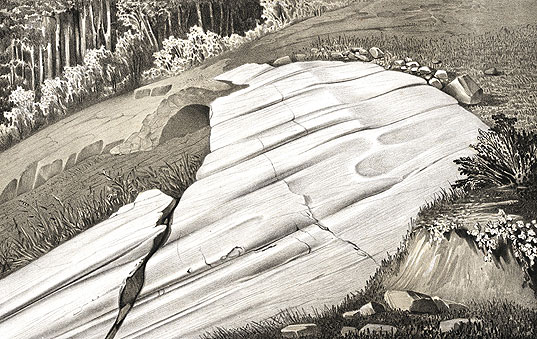 |
| Rocks polished and striated by a glacier Louis Agassiz, from Etudes sur les glaciers, 1840 |
One of his more significant discoveries was made in Scotland when Agassiz finally unlocked the mystery of the parallel roads of Glen Roy when he proposed that the "roads" were not of a marine nature, as was erroneously proposed by Darwin, but were in fact caused by the rapid damming by a glacier of a loch in the period of the Loch Lomond stadial (a mini ice age around 12000 years ago, and lasting for a brief 600 years) and it's subsequent melting, in three stages.
 |
| the parallel roads of Glen Roy |
I've spent much time walking and camping during winter in Glen Roy and have a favourite wild camp spot near Fersit. It's amazing to think that in the relatively recent past, this familiar valley would have been hidden under water, and my wild camp buried under a glacier near the head of Loch Trieg. I've seen the parallel roads marked on the Ordnance Survey maps, always rather assuming that they were indeed "roads", perhaps forestry tracks or some system of roads where a higher track existed to avoid boggy ground, but of course, that would eliminate the need for the lower tracks. Instead, they are completely natural, and lie on the horizontal, mapping, marking and measuring dramatic moments in the valley's past where the ice dams spectacularly broke and the glacial loch drained.
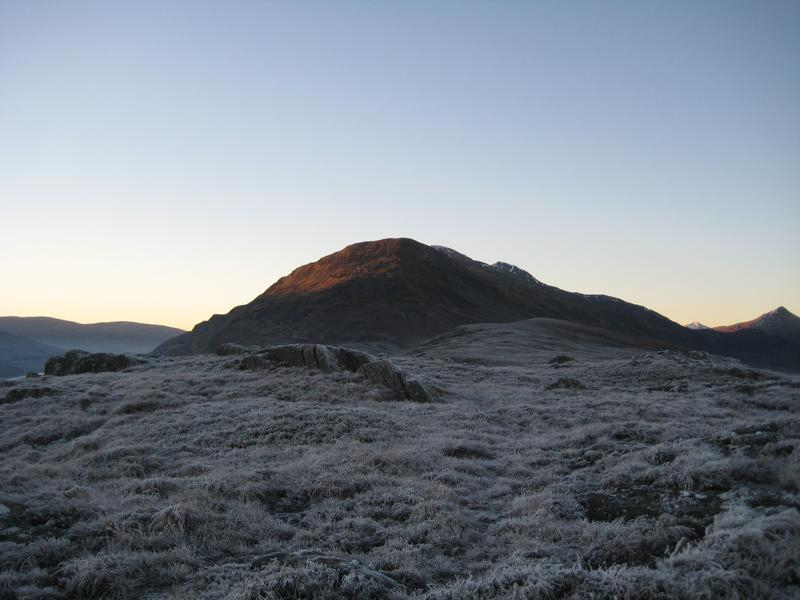 |
| Stob Coire Easain (near Fersit), Dec 19th 2007 |
Saturday, 25 December 2010
Sgurr an Tuill Bhàin, Rock of the White Flood.
 |
| Walking on the summit ridge, descending Slioch, looking towards Sgurr an Tuill Bhan, Dec 2008 |
Sunday, 26 September 2010
midnight mountains
 |
| Stob Coire Easin, graphite on paper, L Punton, 2010 |
 |
| Beinn Eighe, graphite on paper, L Punton 2010 |
 |
| Ben Cruachan, Graphite on Paper, L Punton, 2010 |
Tuesday, 7 September 2010
language of displacement
Hamish Brown points out in his book documenting the first non stop walk of all the Munro's, that in Scotland, despite the variety of words meaning mountain (there's Stob, Sgurr, Stac, Stuc, Carn, Cairn, Cruach, Meall, Mheall, Maol, Mam, Monadh, Druim, Beinn, Ben, Bidean, Binnean, etc), and all the "peaks of the hind" and 'hills of the goat" and other hills descriptive of the land and wildlife found upon them, there is no hill with the Gaelic name for sheep, since they came later - when Gaelic itself was being evicted!
 |
| An Teallach, July 2008 |
Sunday, 22 August 2010
revisiting An Caisteal
After my revisiting Strontian post recently, I thought about those other places I've repeatedly found myself in over time, places of regular pilgrimage or simply habitual return, and I thought about how I've found myself making the "same" photograph on the summit of An Caisteal, a Munro near Crianlairich. I've climbed this hill 7 times now, and by the 5th time, realised I'd begun to make roughly the same summit photograph, looking in the same direction towards Beinn Chabhair and the Arrochar Alps, the weather conditions the main variant between them. Once this realisation had been made, I resolved to continue to make more images on subsequent walks up the mountain.
Co-incidentally, I visited a few exhibitions in Edinburgh yesterday and was also struck by the interesting Alexander & Susan Maris show at Stills, where Alexander Maris also returned to and remade photographs from places he'd visited in his past, also often in mountainous, wild terrain. I think there's something akin to my own process here, something altogether more intimate, more biographical, than that found in Mark Klett's formalised re-photographic survey.
Here are the images I made on An Caisteal. There may well have been more images had I been carrying a camera on the first climbs, though I seem to remember only having a low grade mobile phone camera with me on those occasions, and which I rarely used.

27.11.05

4.3.06

3.4.07

24.3.08
Clearly from the images, I've a fondness for climbing it in the snow. Perhaps it's familiarity and close proximity to home make it a good winter hill for me when the daylight hours are short, though I recollect the earlier ascents were in fine warm weather and took in neighboring Beinn a' Chroin too.
Re-creation as recreation.
Saturday, 27 February 2010
snowfall
These images are from the SAIS blog for Lochaber (Nevis Range) - An offshoot of the Scottish Avalanche Information Service.


The above image shows some off piste cross country ski touring in the col between Aonach Beag and Aonach Mor. Below are some climbers on the North face of Ben Nevis.

There have been disadvantages of course, and with this unprecedented amount of snowfall, there's also been a high incidence of avalanches, something that we're not really used to here, at least, not in the way found in alpine regions. And us Scottish walkers are, I hate to say, quite inexperienced in dealing with them. I know basic avalanche safety, but don't go out with avalanche probe, transcriever etc.

Large hoar frost crystals have formed, and once further accumulations of snow build up on top, this results in a weak layer where the new snowfall easily slides off as avalanches. There have already been many fatalities, and with windslab crust layers forming, the scottish hills are more dangerous right now than many of us have ever seen.
Thursday, 4 February 2010
white out receeding, Carn Dearg, Loch Ossian, 2.3.05

This colour analogue photograph was made on the first of four winter walking trips with my students to the eco hostel on Rannoch Moor beside Loch Ossian. Only four of us climbed on this day (the whole group had had a long walk the day before), and this was a blustery, extremely cold one I seem to remember. The cloud came in and the light became so flat that we couldn't differentiate ground from air, but as it was so windy, we just decided to sit it out and wait for it to clear (which it did ten minutes later). This image was made just as we began to discern the ground again.
Wednesday, 23 December 2009

Tuesday, 15 December 2009
a cold wild camp
On Saturday night, having driven through thick fog, we camped at this spot - 56°51'18.53"N, 5°20'41.36"W (the joys of google earth in working such information out!) hoping to get an early start before climbing Gulvain the next day. At camp, it was a cold clear night that went down to -6 or -7 (at least) and the trees glittered with hoar frost illuminated by the shifting beam of my headtorch. This is a short video clip made that night (the quality is better when viewed directly from the Vimeo link).
There were some fantastic shooting stars in the sky too; it turns out that this was the Geminid meteor shower which reached it's peak on 13th & 14th Dec.
Subscribe to:
Posts (Atom)

