 |
| Landscape with a double rainbow,John Constable,1812, Oil on paper laid on canvas |
Thursday, 15 September 2011


Monday, 29 August 2011
dark cloud constellations : the emu and coalsack nebula
 |
| our campsite in the bush near Gilgandra |
 |
| the sky in the southern hemisphere photographed near Gilgandra, NSW. (click on the image to enlarge enough to view) |
 |
| the "emu" (image by D. Smith) |
Back to solid visible objects, as you drive along the road to Coonabarabran, you pass various models of the planets in our solar system with the 37m dome of Sliding Spring Observatory representing the sun.
 |
| "Jupiter" |
 |
| Jupiter, west of Coonabarabran |
 |
| Neptune, in Gunnedah |
(See also here for a post on the Guugu Yimithirr people of Northern Queensland).
Sunday, 28 August 2011

Saturday, 27 August 2011
fruit bats
A short video I made in the botanical gardens in Sydney of the extraordinary colony of fruit bats. Apparently there are so many of them they are beginning to damage the trees. As the bats are a protected species, the gardeners have been given special dispensation to try to reduce/control their numbers.
Sunday, 21 August 2011
burning mountain part 1
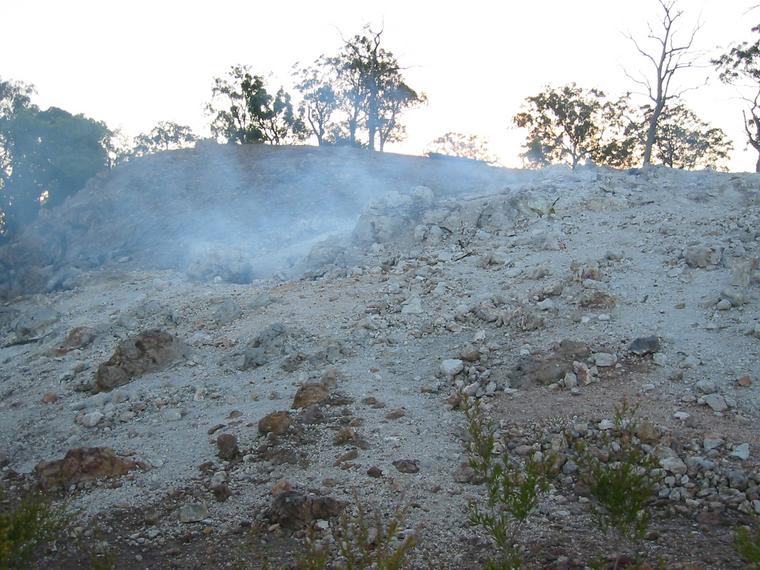 |
| the coal seam at the top of Burning Mountain (Mt Wingen) |
Looking into places to visit on our road trip in Australia (we collect our camper van tomorrow), I'm attracted to a place called Burning Mountain. I'm told "you won't see much there", or more commonly "never heard of it" from various locals here in Sydney, but to me, it looks fascinating. Burning Mountain, or to give it it's proper name, Mount Wingen, was thought to be a volcano, but it's now known to be an underground seam of coal that's thought to have been burning for almost 6000 years. The plant life en route to the summit has suffered, with little growing on the forest floor. The burning head of the seam can be seen and the fire pours out sulphurous gas and smoke.
Wednesday, 10 August 2011
scott's hut
Visiting the exhibition on Scott's hut (and after seeing the recent documentary in the UK on how it had been preserved at Cape Evans) I was looking forward to seeing it's recreation in Sydney at the National Maritime Museum. Unfortunately, it hasn't really been recreated; all there is, is a floor map not unlike the stage set for Lars von Trier's Dogville and Manderlay, mapping on the floor the relative positions of where the crew would have slept etc.
In the gift shop, things got worse, with poor old Robert Falcon's fate reduced to a snowstorm paperweight. Not sure whether it's hilarious or in bad taste..
 |
| the real Scott's hut at Cape Evans, Antarctica |
In the gift shop, things got worse, with poor old Robert Falcon's fate reduced to a snowstorm paperweight. Not sure whether it's hilarious or in bad taste..
Friday, 5 August 2011
challenges to navigation
Having just arrived in Sydney, Australia, and going out walking after sunset (abruptly early having come from our Scottish summer with long hours of daylight) we looked up to the winter night sky and it occurred to us that we didn't recognise anything.


Similarly, orienting oneself with sun proves confusing until one realises that whilst the sun still rises in the east and sets in the west, it's movement over the sky is in the northern half of the sky, as opposed to the south in the northern hemisphere.
"The shadow of a sun dial moves clockwise in the northern hemisphere (opposite of the southern hemisphere). During the day the sun tends to raise to its maximum at a southerly position, whereas in the southern hemisphere it raises to a maximum that is northerly in position (as it tends towards the direction of the equator). In both hemispheres the sun rises in the east and sets in the west."
Climbing mountains here, the North face is the gentler side, the more temperate.
"The shadow of a sun dial moves clockwise in the northern hemisphere (opposite of the southern hemisphere). During the day the sun tends to raise to its maximum at a southerly position, whereas in the southern hemisphere it raises to a maximum that is northerly in position (as it tends towards the direction of the equator). In both hemispheres the sun rises in the east and sets in the west."
 |
| the night sky in the Southern Hemisphere |
Friday, 29 July 2011
thoughts on walking
I attended a symposium at the Scottish National Gallery of Modern art yesterday entitled Critical dialogues on Walking, Art, Landskip and Knowledge with presentations by Alec Finlay, Matthew Beaumont, and Misha Myers, part of the Walking, Art, Landskip (sic) and Knowledge Reasearch Group at the University of Sunderland.
Almost as an aside however, Matthew Beaumont showed this slide by Eadweard Muybridge amongst many others in an idiosyncratic presentation "beginning with the big toe - a peregrination on bipedal plantigrade locomotion" (or as I interpreted it, a cultural and physiological history of the big toe).
I felt closest and most sympathetic to Eck's presentation, where he spoke of various walks from his history, and I was especially pleased to listen to his description of his daily family walk from his childhood in Stoneypath, where he recounted so much topographical detail as to almost present us with a form of verbal cartography.
 |
Eadweard Muybridge, girl running, Collotype, 1887, 203x318mm
|
My 10 month old son recently started walking. I've been interested in the connections between art and walking and their relationship to process for a long time now, but for some reason didn't connect Angus' tentative learning of a new skill with the more conceptually based ruminations and meditations on walking in relation to my art practice until I saw this Muybridge photograph again.
His tentative first steps are becoming more steady, and he crawls less, but still he falls often although we no longer measure his achievement by counting his steps - they're far too numerous for that. But this too reminds me of Laurie Anderson's brilliant "walking and falling", a work that's personally very dear to me.
Falling, falling down, falling in love, free falling, foot-fall, falling slowly; falling seems to metaphorically sit as an edgy counterpane to the activity of walking, of attempting to find stability, to move oneself forward, step by step.
 |
| Thomas Eakins, Marey wheel photographs of unidentified model, c.1884 |
Friday, 15 July 2011
rafts
Earlier in the week, a group of us (mostly children) made some rafts to sail down Loch Aline. This is my effort made from twigs, grass and leaves. The first image is pre-launch, with the second in the water. Great fun.


Wednesday, 6 July 2011
the photographs of frank hurley
 |
| a radiant turret lit by the midsummer midnight sun Made during the first Australasian Antarctic expedition, 1911-14 |
I think I find Hurley's work more interesting because it seems more varied and often, more intimate, showing details on a human scale. There are of course many wonderful and breathtakingly beautiful images of ice landscapes by Hurley that display grandeur and are intended to create a sense of awe in the viewer, such as in the image above, but his pictures often also seem to contain details that pleasingly undermine this distance from the subject, or which manage to convey some of the physicality of place that can be difficult in the stilled form of the photograph.
 |
| Out in the blizzard at Cape Denison adjacent to winter quarters, 1913, Carbon print |

scientific/heroic/pictorialist basis to the creation of the picture (unlike most of the others) and the purpose of the image remains unclear. (I'm guessing that perhaps a snow hole has been dug, with the occupants' artificial light illuminating the entrance, but it's still significantly obscure to continue to intrigue and hold my attention).

The image below is perhaps more conventional, but still I like the presence of the man, looking out to the ice, Caspar David Friedrich-like. With his hands in his pockets, and wearing a balaclava but no coat, braces visible, he stands so very casually as he surveys the ice and the unending immensity of the cold horizon beyond. He looks as though he might just have been passing by for a stroll when Hurley made the picture. Perhaps he was.

He also made a series of early colour images of the Expedition using the then-popular Paget process of colour photography. The colours are rather weak, and the autochrome process would supersede it, but it still comes as something of a shock to see them at all. Even it's failures hold beauty.
 |
| Mid-summer, 1915 |
 |
| Unidentified landscape |
Tuesday, 31 May 2011

Sunday, 22 May 2011
the great white silence
I watched Herbert Ponting's film of the British Antarctic Expedition of 1910-12 at the cinema today, where Capt. Robert Falcon Scott led the attempt to be the first to reach the South Pole. Newly restored by the BFI, the film is certainly worth seeing if you have the chance. It's redolent with an outdated version of English patrioism and heroism, but that is probably to be expected considering this was the officially sanctioned document of the expedition.
But watching it in the light of more recent criticism of Scott's strategies, notably the excellent I may be some time by Frances Spufford, the expedition's use of Siberian ponies and a forerunner to the tank to haul loads looked foolish even before they set out on their journey across the empty continent. The dogs, however, look brilliantly adapted to the task, relishing the work in the way the horses never would. Had they used the dogs to pull the sleds, they'd likely have survived to tell the tale - though perhaps we'd not still be thinking of them had the story had such a banal ending - simply coming second to the Norwegians. Amundsen in many ways deserved to reach the pole first, being less arrogant that he might "conquor" the antarctic wilderness, and humble enough to employ the survival techniques of indigenous peoples of the polar regions, rather than bringing in European style expedition tactics.
What perhaps surprised me more about the film though, was the use of colour filters (not unlike the gel overlays in the 1925 Lon Chaney version of The Phantom of the Opera), creating different atmospheres for time of year, quality of light, and location. Even more noteworthy, I think, are the little animated sequences that appear to, at first, be time lapse views from high up of the sleds being manhauled over the Beardmore Glacier, but which soon become clearly made in a studio once Ponting got back home. The're a little comic, with their jerky movements, looking like bizarre dolls house props, but I found them interesting all the same. I was strangely reminded of Sonja Braas' forces series, when looking at these sections.
I did find the extended footage of the penguins a little tiresome (Werner Herzog truly got it right in Encounters at the End of the World), and their anthropomorphism in Ponting's intercut text/narrative irked a little, but there's no doubting that this is an exceptionally privileged account of an adventure and tragedy made with great skill and beauty.
But watching it in the light of more recent criticism of Scott's strategies, notably the excellent I may be some time by Frances Spufford, the expedition's use of Siberian ponies and a forerunner to the tank to haul loads looked foolish even before they set out on their journey across the empty continent. The dogs, however, look brilliantly adapted to the task, relishing the work in the way the horses never would. Had they used the dogs to pull the sleds, they'd likely have survived to tell the tale - though perhaps we'd not still be thinking of them had the story had such a banal ending - simply coming second to the Norwegians. Amundsen in many ways deserved to reach the pole first, being less arrogant that he might "conquor" the antarctic wilderness, and humble enough to employ the survival techniques of indigenous peoples of the polar regions, rather than bringing in European style expedition tactics.
One can't help but think, "these men would soon die" when watching the film. Like all old photographs, they're infused with a sense of mortality, but our knowledge of the outcome of the expedition makes the sense of pathos palpable. In the end, they would die stormbound in their tent a mere 11 miles from the safety of "one ton depot". At the beginning of the film as they set sail from New Zealand, they look so strong and potent that failure must have seemed inconceivable to those around them.
What perhaps surprised me more about the film though, was the use of colour filters (not unlike the gel overlays in the 1925 Lon Chaney version of The Phantom of the Opera), creating different atmospheres for time of year, quality of light, and location. Even more noteworthy, I think, are the little animated sequences that appear to, at first, be time lapse views from high up of the sleds being manhauled over the Beardmore Glacier, but which soon become clearly made in a studio once Ponting got back home. The're a little comic, with their jerky movements, looking like bizarre dolls house props, but I found them interesting all the same. I was strangely reminded of Sonja Braas' forces series, when looking at these sections.
 |
| Sonja Braas, Forces No 10, 2002, c-print behind diasec |
I did find the extended footage of the penguins a little tiresome (Werner Herzog truly got it right in Encounters at the End of the World), and their anthropomorphism in Ponting's intercut text/narrative irked a little, but there's no doubting that this is an exceptionally privileged account of an adventure and tragedy made with great skill and beauty.
Friday, 20 May 2011
dirtying the paper delicately

Attending a meeting at work yesterday where staff were assembled to talk about drawing, I heard the wonderful phrase "dirtying the paper gently" used in describing the act of drawing. Stephen Farthing, our guest who had the previous day given a lecture on drawing (which I missed, sadly), borrowed the phrase from Ruskin. In fact, Ruskin said that "all art is but dirtying the paper delicately" in The Elements of Drawing. It seems to be such a wonderfully poetic description for the activity that forms the majority of my creative practice, particularly the recent works using powdered graphite such as Gravesend and Grindelwald.
Here too, is another work by Ruskin, one of many pieces he created in Chamonix in the French Alps, and another which shows his interest in geology. Indeed, in Modern Painters, Ruskin displays an obsessive attention to classifying every detail and permutation of rock formation and landscape feature, all dirtying the paper delicately.
 |
| John Ruskin, Cascade de la Folie, Chamonix, 1849 pen & ink, watercolour and bodycolour on paper |
 |
| John Ruskin, Aguille structure, 1856 (engraved by JC Armytage) |
Tuesday, 17 May 2011
the mountains of Holland base camp
 |
| Thomas A Clark, 2011 |

Tuesday, 10 May 2011
the fram
 |
| Blankets from the cabin of The Fram. L Punton 2006/2011 |
Subscribe to:
Posts (Atom)

