Wednesday, 16 November 2011


Tuesday, 1 November 2011
Schiehallion bivvy part 2
I posted some time back about my experience of bivvying on the summit of the mountain Schiehallion, where Jim & I created two pinhole photographs. I also filmed much of the creation of the work and have finally edited it.
Thursday, 20 October 2011
burning mountain part 2
I mentioned in an earlier blog post that during my recent trip to Australia, I was hoping to visit a place known colloquially as "burning mountain". Well, I did manage to get there, and indeed, to climb the mountain. On Mount Wingen, (it's official name) there's an underground coal seam that has been burning for around 6000 years and which currently reaches the surface almost at the very summit of the hill, a fortunate occurrence it seems. Long thought to be a volcano, it's only relatively recently that it's existence as the oldest naturally burning coal seam on earth has been confirmed.
The term mountain is, to my Munro climbing eyes, a bit of a misnomer as the summit can be reached by a well constructed pathway in about an hour. As you reach the summit field, you reach a raised deck designed to keep you off of the friable, brittle earth. There's no smoke dramatically billowing from holes; only a gentle warmth in the air. There's a strangely pleasant and mild smell of sulphur that reminds me of the glass jar filled cabinets of the chemistry lab of my school days, and an awareness that the ground resembles the burnt out embers of a coal fire. Bird song, exotic to my Northern European ears, resounds all around.
Once you ignore the warnings and leave the safety of the deck, the true nature of the hill begins to reveal itself. The smell of sulphur stays the same and you become quite acclimatised to it, but you gradually notice more that the ground is not quite the same as anywhere else you've ever been. Cracks and chasms open up where the seam has riven open the ground during the burning head's passage years earlier. The sharp, brittle, almost hollow nature of the ground is confirmed as your feet crunch upon the pale burnt out embers as you pass slowly over them. Then you begin to really sense heat, more than just mere warmth. A heat haze rises from patches of the ground, sometimes only very faintly. There are kangaroo droppings where the ground is pleasantly warm, the animals clearly using the hill top to find solace during the night. And finally, as you've wandered the summit field, you edge over to one side to discover the burning head of the seam and are met by a fierce heat. Not so hot that you can't stand upon it, but hot enough that you wonder whether the soles of your shoes will melt a little, and that radiates an intense heat towards your face that quickly becomes oppressive. I film the experience with my camera, and the heat at this climax causes my lens to flare in bursts. I look down at my footprints and think of Armstrong and Aldrin's on the lunar surface, the texture seeming so oddly similar.
Of course, most will also have noticed on the way up that the ground moves gradually from being fertile and populated by vegetation, to a forest floor where not much grows, the burning head having passed below in the past. Those more observant and educated in such things may recognise a shift in the types of gum trees that grow along the way from eucalyptus that thrives in temperate areas, to those more commonly seen on the fringes of the outback and capable of withstanding greater heat and aridity.
(note, detail of heat haze in the above video is more clearly visible when viewed on Vimeo)
Monday, 10 October 2011

Monday, 19 September 2011
coffee grounds
Back from Sydney, Jim and I showed the collaborative work we made in Australia at Vault Art the other weekend. For that we exhibited 12 of the 28 images we made in our series "coffee grounds". They were created by photographing the remains of our coffee left in the bottom of our cup each morning and made negative, although other than that, there is very little manipulation.
Here is a selection from the series.


Here is a selection from the series.


Thursday, 15 September 2011

Monday, 29 August 2011
dark cloud constellations : the emu and coalsack nebula
 |
| our campsite in the bush near Gilgandra |
 |
| the sky in the southern hemisphere photographed near Gilgandra, NSW. (click on the image to enlarge enough to view) |
 |
| the "emu" (image by D. Smith) |
Back to solid visible objects, as you drive along the road to Coonabarabran, you pass various models of the planets in our solar system with the 37m dome of Sliding Spring Observatory representing the sun.
 |
| "Jupiter" |
 |
| Jupiter, west of Coonabarabran |
 |
| Neptune, in Gunnedah |
(See also here for a post on the Guugu Yimithirr people of Northern Queensland).
Sunday, 28 August 2011

Saturday, 27 August 2011
fruit bats
A short video I made in the botanical gardens in Sydney of the extraordinary colony of fruit bats. Apparently there are so many of them they are beginning to damage the trees. As the bats are a protected species, the gardeners have been given special dispensation to try to reduce/control their numbers.
Sunday, 21 August 2011
burning mountain part 1
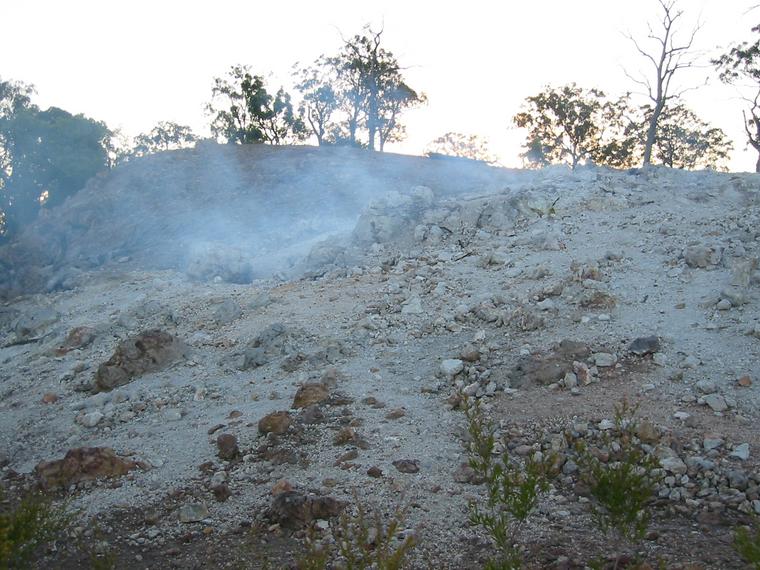 |
| the coal seam at the top of Burning Mountain (Mt Wingen) |
Looking into places to visit on our road trip in Australia (we collect our camper van tomorrow), I'm attracted to a place called Burning Mountain. I'm told "you won't see much there", or more commonly "never heard of it" from various locals here in Sydney, but to me, it looks fascinating. Burning Mountain, or to give it it's proper name, Mount Wingen, was thought to be a volcano, but it's now known to be an underground seam of coal that's thought to have been burning for almost 6000 years. The plant life en route to the summit has suffered, with little growing on the forest floor. The burning head of the seam can be seen and the fire pours out sulphurous gas and smoke.
Wednesday, 10 August 2011
scott's hut
Visiting the exhibition on Scott's hut (and after seeing the recent documentary in the UK on how it had been preserved at Cape Evans) I was looking forward to seeing it's recreation in Sydney at the National Maritime Museum. Unfortunately, it hasn't really been recreated; all there is, is a floor map not unlike the stage set for Lars von Trier's Dogville and Manderlay, mapping on the floor the relative positions of where the crew would have slept etc.
In the gift shop, things got worse, with poor old Robert Falcon's fate reduced to a snowstorm paperweight. Not sure whether it's hilarious or in bad taste..
 |
| the real Scott's hut at Cape Evans, Antarctica |
In the gift shop, things got worse, with poor old Robert Falcon's fate reduced to a snowstorm paperweight. Not sure whether it's hilarious or in bad taste..
Friday, 5 August 2011
challenges to navigation
Having just arrived in Sydney, Australia, and going out walking after sunset (abruptly early having come from our Scottish summer with long hours of daylight) we looked up to the winter night sky and it occurred to us that we didn't recognise anything.


Similarly, orienting oneself with sun proves confusing until one realises that whilst the sun still rises in the east and sets in the west, it's movement over the sky is in the northern half of the sky, as opposed to the south in the northern hemisphere.
"The shadow of a sun dial moves clockwise in the northern hemisphere (opposite of the southern hemisphere). During the day the sun tends to raise to its maximum at a southerly position, whereas in the southern hemisphere it raises to a maximum that is northerly in position (as it tends towards the direction of the equator). In both hemispheres the sun rises in the east and sets in the west."
Climbing mountains here, the North face is the gentler side, the more temperate.
"The shadow of a sun dial moves clockwise in the northern hemisphere (opposite of the southern hemisphere). During the day the sun tends to raise to its maximum at a southerly position, whereas in the southern hemisphere it raises to a maximum that is northerly in position (as it tends towards the direction of the equator). In both hemispheres the sun rises in the east and sets in the west."
 |
| the night sky in the Southern Hemisphere |
Friday, 29 July 2011
thoughts on walking
I attended a symposium at the Scottish National Gallery of Modern art yesterday entitled Critical dialogues on Walking, Art, Landskip and Knowledge with presentations by Alec Finlay, Matthew Beaumont, and Misha Myers, part of the Walking, Art, Landskip (sic) and Knowledge Reasearch Group at the University of Sunderland.
Almost as an aside however, Matthew Beaumont showed this slide by Eadweard Muybridge amongst many others in an idiosyncratic presentation "beginning with the big toe - a peregrination on bipedal plantigrade locomotion" (or as I interpreted it, a cultural and physiological history of the big toe).
I felt closest and most sympathetic to Eck's presentation, where he spoke of various walks from his history, and I was especially pleased to listen to his description of his daily family walk from his childhood in Stoneypath, where he recounted so much topographical detail as to almost present us with a form of verbal cartography.
 |
Eadweard Muybridge, girl running, Collotype, 1887, 203x318mm
|
My 10 month old son recently started walking. I've been interested in the connections between art and walking and their relationship to process for a long time now, but for some reason didn't connect Angus' tentative learning of a new skill with the more conceptually based ruminations and meditations on walking in relation to my art practice until I saw this Muybridge photograph again.
His tentative first steps are becoming more steady, and he crawls less, but still he falls often although we no longer measure his achievement by counting his steps - they're far too numerous for that. But this too reminds me of Laurie Anderson's brilliant "walking and falling", a work that's personally very dear to me.
Falling, falling down, falling in love, free falling, foot-fall, falling slowly; falling seems to metaphorically sit as an edgy counterpane to the activity of walking, of attempting to find stability, to move oneself forward, step by step.
 |
| Thomas Eakins, Marey wheel photographs of unidentified model, c.1884 |
Friday, 15 July 2011
rafts
Earlier in the week, a group of us (mostly children) made some rafts to sail down Loch Aline. This is my effort made from twigs, grass and leaves. The first image is pre-launch, with the second in the water. Great fun.


Wednesday, 6 July 2011
the photographs of frank hurley
 |
| a radiant turret lit by the midsummer midnight sun Made during the first Australasian Antarctic expedition, 1911-14 |
I think I find Hurley's work more interesting because it seems more varied and often, more intimate, showing details on a human scale. There are of course many wonderful and breathtakingly beautiful images of ice landscapes by Hurley that display grandeur and are intended to create a sense of awe in the viewer, such as in the image above, but his pictures often also seem to contain details that pleasingly undermine this distance from the subject, or which manage to convey some of the physicality of place that can be difficult in the stilled form of the photograph.
 |
| Out in the blizzard at Cape Denison adjacent to winter quarters, 1913, Carbon print |

scientific/heroic/pictorialist basis to the creation of the picture (unlike most of the others) and the purpose of the image remains unclear. (I'm guessing that perhaps a snow hole has been dug, with the occupants' artificial light illuminating the entrance, but it's still significantly obscure to continue to intrigue and hold my attention).

The image below is perhaps more conventional, but still I like the presence of the man, looking out to the ice, Caspar David Friedrich-like. With his hands in his pockets, and wearing a balaclava but no coat, braces visible, he stands so very casually as he surveys the ice and the unending immensity of the cold horizon beyond. He looks as though he might just have been passing by for a stroll when Hurley made the picture. Perhaps he was.

He also made a series of early colour images of the Expedition using the then-popular Paget process of colour photography. The colours are rather weak, and the autochrome process would supersede it, but it still comes as something of a shock to see them at all. Even it's failures hold beauty.
 |
| Mid-summer, 1915 |
 |
| Unidentified landscape |
Subscribe to:
Posts (Atom)

