Sunday, 29 August 2010

with the advent of radio astronomy..


Cerith Wyn Evans
Digitally-cut grey matt finish vinyl adhesive
dimensions variable,
2010

Sunday, 22 August 2010

revisiting An Caisteal


After my revisiting Strontian post recently, I thought about those other places I've repeatedly found myself in over time, places of regular pilgrimage or simply habitual return, and I thought about how I've found myself making the "same" photograph on the summit of An Caisteal, a Munro near Crianlairich. I've climbed this hill 7 times now, and by the 5th time, realised I'd begun to make roughly the same summit photograph, looking in the same direction towards Beinn Chabhair and the Arrochar Alps, the weather conditions the main variant between them. Once this realisation had been made, I resolved to continue to make more images on subsequent walks up the mountain.

Co-incidentally, I visited a few exhibitions in Edinburgh yesterday and was also struck by the interesting Alexander & Susan Maris show at Stills, where Alexander Maris also returned to and remade photographs from places he'd visited in his past, also often in mountainous, wild terrain. I think there's something akin to my own process here, something altogether more intimate, more biographical, than that found in Mark Klett's formalised re-photographic survey.

Here are the images I made on An Caisteal. There may well have been more images had I been carrying a camera on the first climbs, though I seem to remember only having a low grade mobile phone camera with me on those occasions, and which I rarely used.

27.11.05

4.3.06

3.4.07

 24.3.08

Clearly from the images, I've a fondness for climbing it in the snow. Perhaps it's familiarity and close proximity to home make it a good winter hill for me when the daylight hours are short, though I recollect the earlier ascents were in fine warm weather and took in neighboring Beinn a' Chroin too.

Re-creation as recreation.


Tuesday, 17 August 2010

strength through joy...?

Looking for some images of the cliffs at Rügen (in order to see images of the famous chalk cliffs Caspar David Friedrich painted but which partially collapsed in a landslide a few years ago), instead, I somehow found myself looking at an altogether different spectacle of the sublime. Built by Hitler as part of the Strength Through Joy programme (basically, a kind of National Socialist leisure industry wing - which also brought us the VW Beetle), Prora was a 4.5km long hotel (one continuous structure) in which all the rooms had a sea view, providing accommodation for 20,000 people on the Baltic Sea. It's also known as the "Colossus of Rügen, and it's extraordinary to think of a "holiday camp" built on such an imposing, daunting scale. Butlin's x 100!


arial view of Prora

Built between 1936 and 1939, it was designed to provide affordable holidays for the average worker, but with the onset of war, construction stopped. The eight housing blocks, the theatre and cinema stayed as empty shells, and the swimming pools and festival hall never materialised. 
During the Allied bombing campaign, many people from Hamburg took refuge in one of the housing blocks, and later refugees from the east of Germany were housed there. By the end of the war, these buildings served to house female auxiliary personnel for the Luftwaffe.


These images by Vegar Moen show the building and it's environs in 2001.


After the war, Rügen ended up in the Russian sector and Prora became a top-secret army base, a virtual university of warfare, where Warsaw Pact troops rehearsed for a Third World War. The holiday camp that Hitler built became a hi-tech military training camp, where Soviet soldiers played wargames to prepare for the apocalypse to come. Out of bounds to locals, Prora disappeared from East German maps. A wild wood grew up around it, hiding it from the sea.

Saturday, 14 August 2010

waiting


Samuel Beckett claimed that this painting, two men contemplating the moon, was his inspiration for Waiting for Godot.


He subsequently said that this image, man and woman contemplating the moon was his inspiration, but they are so similar, that clearly the influence was strong.


Both paintings are in the Nationalgalerie, Berlin, and both are identical in size at 34x44cm.

Friday, 13 August 2010

stargazing

The Perseids meteor shower reached it's peak on Thursday night/Friday morning, though there's still a couple of days more in which to see them. The radiant point for this shower will be in the constellation Perseus. The thin, crescent moon will be out of the way early, setting the stage for a potentially spectacular show. For best viewing, look to the northeast after midnight.


Saturday, 24 July 2010

revisiting Strontian

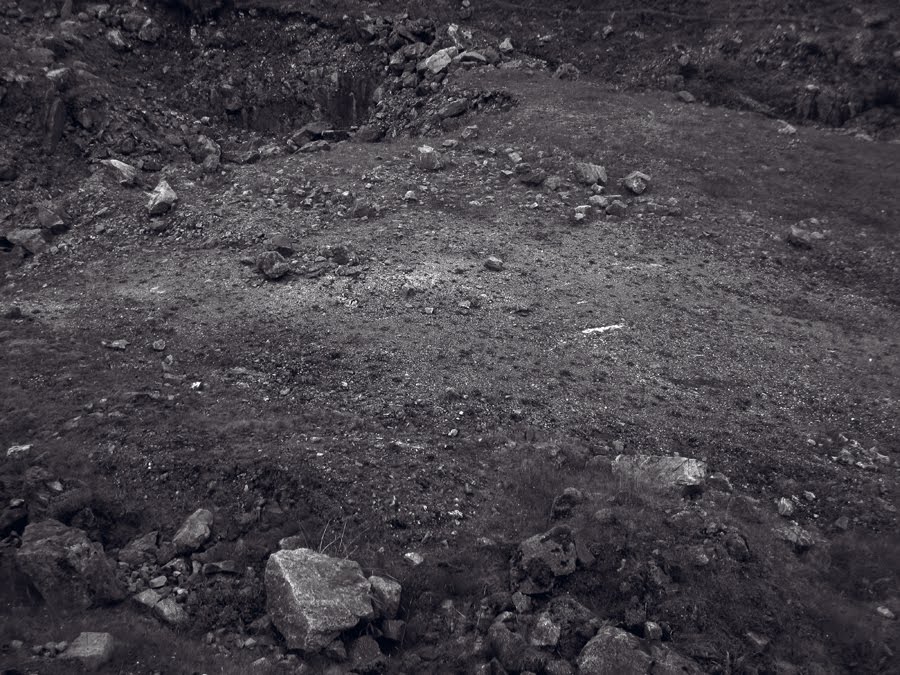
Some years ago, I made a series of black and white images on 5x4 polaroid of the lead mines by Strontian in Lochaber, Scotland. Initially inspired by a desire to revisit a place from childhood that I felt was like the surface of the moon, I went back and, unusually, wasn't disappointed by the emotions it generated. The place was, indeed, just as I remembered it, and my childhood recollections somehow remained intact. (Re-visitation is often a disappointment, and something I think I normally approach with caution). The images were from a wider series where I was interested in this idea of recreating or finding a space to act as a surrogate for the lunar landscape, a place both barren yet beautiful, and I made images in quarries, others at the base of the chalk cliffs at Beachy Head on the south coast of England, more still in Swedish Lappland, and finally, in the old lead mines of Strontian.
Strontian, July 2010

It's a curious thing to go to Strontian and try to find out more about the history of the mines, and of the place where the element Strontium was discovered. Considering the element was named after the village, they tend not to make much of this fact. The tourist information office "used to have some leaflets, but they're out of print now".
Strontium was recognized as distinct from barium in 1790 by Adair Crawford in a mineral sample from one of the lead mines  and the metal first isolated by Sir Humphry Davy in 1808. I was always aware of this metallic quality to the ground there, mainly through my memories of hunting for bits of lead in the rocks strewn around these predominantly opencast mines (though a number of deep shafts are still visible and dangerous), and this idea of a magnetic, or chemical "pull" always fascinated me.
So on our recent trip north, I decided to show Jim the location where I originally made these photographs. Last time I was here (it must have been around 1997/8), I carried a 5x4 camera, heavy duty tripod, double dark slides and ordinary 5x4 film, dark cloth, changing bag, polaroid type 55 film and holder, a clearing bucket containing in the region of 1 litre of sodium sulphite solution (I was living in London at the time and had come a long way, so wanted to see the results there and then) as well as the usual walking gear/paraphenalia. This time we had a small digital camera.
I easily found the locations of some of the original images, and together Jim and I recreated those images loosely from memory. The originals are large scale silver gelatin prints, so I need to find them to re-photograph them, but in the meantime, this post shows two of those images made last week.
 Strontian, July 2010

Monday, 19 July 2010

nest building

It seems appropriate to be thinking of building nests right now (7 and a half weeks to go!) so I thought I'd post these images of nests created by bowerbirds. They're from National Geographic, and the images are by Tim Laman. They're quite extraordinary constructions which can really only be described as 'home decoration'. I would like to point out that in this species though, it's the male that likes to arrange the soft furnishings!


..I think I have a special fondness for this one with two cans of coke and some sweetie wrappers attempting to lure the female to his pad.


Friday, 16 July 2010

Fog Line

Thanks to Tor for sharing this - Larry Gottheim's 1970 short film Fog Line. 11 minutes of fog imperceptibly but inexorably dissipating in a rural landscape.

Thursday, 15 July 2010

encounter with an otter

Driving just outside of the village of Strontian, an otter crossed the road in front of our car today. Like the encounter with the puffin on Staffa, this too was a fleeting experience.

Here's an old silent BFI film from 1912 of the first known filmed recordings of an otter swimming underwater including a brief glimpse of the cameramen setting up their tank/equipment. The subtitles between shots are infuriatingly long and protracted and some of the "facts" are a bit dubious (otters belonging to the "bear tribe"...?), but the footage itself is lovely.

Wednesday, 14 July 2010

the sound of the corncrake

En route back to Mull from Staffa, we stopped off on Iona for a little while and heard the rare sound of the corncrake. It seems this is an established site for them. This link on you tube is of the very same field in which I encountered the bird. The weather was pretty much identical too!

Tuesday, 13 July 2010

different timelines


I visited the small island of Staffa, (from the Old Norse for stave, or pillar island) off the west coast of Scotland yesterday, catching a small boat from the Isle of Mull. With only a relatively short time on the island, our two main aims were to walk down to Fingal’s cave and then walk to the other end of the island in the hope of seeing some puffins.


The remarkable geological formations on Staffa are justifiably renowned, having inspired artists, writers and musicians over the years, with Felix Mendelssohn’s Hebrides Overture perhaps being the most famous work made in it’s honour. Others that have visited and found inspiration are Turner, August Strindberg, and Sir Walter Scott.

It’s great to find an important heritage site in the UK which you can freely enter without health & safety regulations compromising the experience, and walk right to the very back of the cave. Inside, a deep booming can be heard as the sound of the sea dramatically crashes at the cave end, resonating and echoing throughout.


Staffa is a relative lightweight in terms of Geological age – a mere 55-58 million years compared to it’s aged neighbour Iona which weighs in at a hefty 2800 million years (composed, as it is, of Lewisian gneiss with Torridonian sandstone), and Staffa’s dramatic forms are created from volcanic basalt which appears to thrust from the sea in regular columns that are predominantly hexagonal in shape. There are three layers of rock: the base is composed of tuff, the second layer is columnar basalt, and the top, which forms the roof of Fingal’s cave is amorphous basalt. In the columnar layer, the cooling surface of the mass of hot lava cracked in a hexagonal pattern in a similar way to how drying mud cracks as it shrinks, and these cracks gradually extended down into the mass of lava as it cooled and shrank to form the columns, which were subsequently exposed by erosion.


Once we viewed the cave, we headed up to the other end of the island to see if we might catch a glimpse of some puffins. An extraordinary thing happened. I sat down on the cliff edge and within 15-20 seconds, a puffin flew straight towards me and landed in a hole around three feet from where I was sitting. In its beak were a couple of tiny sand eels, and after a minute in the hole, it flew out to, presumably, catch more food. Needless to say, the swiftness of the experience meant that I didn’t catch it on camera – but then on this instance a camera would have impinged upon the experience itself. Some things are more precious because of their fleetingness.

encounter with a dragonfly


...during a walk to  Loch Tearnait, Morvern.

Saturday, 3 July 2010

the hidden place II

Thanks to Peter Foolen for putting this piece of work by Tom Clark on his blog. A beautiful work citing the translations of many a Scottish place name from their roots in Gaelic, Pictish, Norse, English, French, Latin and Scots, revealing a physical, poetically descriptive and lived connectedness to landscape. As a hill walker, I've grown to know the original Gaelic names but, having only a smattering of Gaelic words in my vocabulary, was always struck by the starkly simple descriptiveness of a great many hill names in translation (Ben More = big hill, Beinn Dearg = red hill, Sgurr Mohr = big rocky hill, and so on) so this piece brings some poetry and lyricism back to my understanding of our map and reveals to me a new depth to the naming of my land.

Thomas A Clark : the hidden place II, 2010

blue spine

Friend and colleague Shauna McMullan recently created this piece at the Mitchell Library in Glasgow which marks the relocation of the Glasgow Women's Library to it's new home in the Mitchell. Shauna invited over 500 women to loan her a copy of a book written by a woman that has a predominantly blue spine. I (like two other contributors) chose Kathleen Jamie's "Findings".