Saturday, 24 July 2010

revisiting Strontian

Some years ago, I made a series of black and white images on 5x4 polaroid of the lead mines by Strontian in Lochaber, Scotland. Initially inspired by a desire to revisit a place from childhood that I felt was like the surface of the moon, I went back and, unusually, wasn't disappointed by the emotions it generated. The place was, indeed, just as I remembered it, and my childhood recollections somehow remained intact. (Re-visitation is often a disappointment, and something I think I normally approach with caution). The images were from a wider series where I was interested in this idea of recreating or finding a space to act as a surrogate for the lunar landscape, a place both barren yet beautiful, and I made images in quarries, others at the base of the chalk cliffs at Beachy Head on the south coast of England, more still in Swedish Lappland, and finally, in the old lead mines of Strontian.
Strontian, July 2010

It's a curious thing to go to Strontian and try to find out more about the history of the mines, and of the place where the element Strontium was discovered. Considering the element was named after the village, they tend not to make much of this fact. The tourist information office "used to have some leaflets, but they're out of print now".
Strontium was recognized as distinct from barium in 1790 by Adair Crawford in a mineral sample from one of the lead mines  and the metal first isolated by Sir Humphry Davy in 1808. I was always aware of this metallic quality to the ground there, mainly through my memories of hunting for bits of lead in the rocks strewn around these predominantly opencast mines (though a number of deep shafts are still visible and dangerous), and this idea of a magnetic, or chemical "pull" always fascinated me.
So on our recent trip north, I decided to show Jim the location where I originally made these photographs. Last time I was here (it must have been around 1997/8), I carried a 5x4 camera, heavy duty tripod, double dark slides and ordinary 5x4 film, dark cloth, changing bag, polaroid type 55 film and holder, a clearing bucket containing in the region of 1 litre of sodium sulphite solution (I was living in London at the time and had come a long way, so wanted to see the results there and then) as well as the usual walking gear/paraphenalia. This time we had a small digital camera.
I easily found the locations of some of the original images, and together Jim and I recreated those images loosely from memory. The originals are large scale silver gelatin prints, so I need to find them to re-photograph them, but in the meantime, this post shows two of those images made last week.
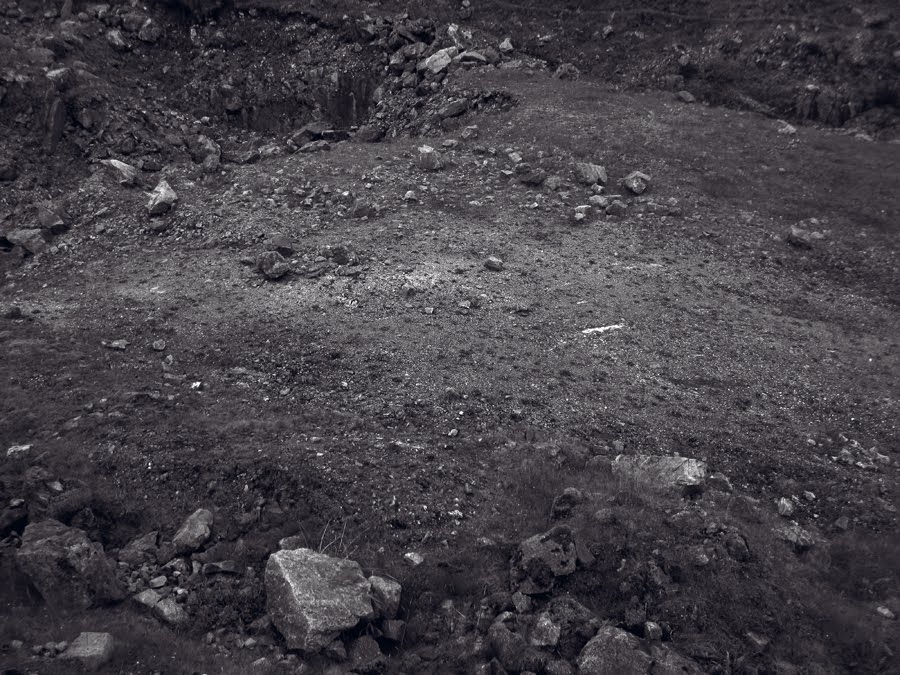
 Strontian, July 2010

Monday, 19 July 2010

nest building

It seems appropriate to be thinking of building nests right now (7 and a half weeks to go!) so I thought I'd post these images of nests created by bowerbirds. They're from National Geographic, and the images are by Tim Laman. They're quite extraordinary constructions which can really only be described as 'home decoration'. I would like to point out that in this species though, it's the male that likes to arrange the soft furnishings!


..I think I have a special fondness for this one with two cans of coke and some sweetie wrappers attempting to lure the female to his pad.


Friday, 16 July 2010

Fog Line

Thanks to Tor for sharing this - Larry Gottheim's 1970 short film Fog Line. 11 minutes of fog imperceptibly but inexorably dissipating in a rural landscape.

Thursday, 15 July 2010

encounter with an otter

Driving just outside of the village of Strontian, an otter crossed the road in front of our car today. Like the encounter with the puffin on Staffa, this too was a fleeting experience.

Here's an old silent BFI film from 1912 of the first known filmed recordings of an otter swimming underwater including a brief glimpse of the cameramen setting up their tank/equipment. The subtitles between shots are infuriatingly long and protracted and some of the "facts" are a bit dubious (otters belonging to the "bear tribe"...?), but the footage itself is lovely.

Wednesday, 14 July 2010

the sound of the corncrake

En route back to Mull from Staffa, we stopped off on Iona for a little while and heard the rare sound of the corncrake. It seems this is an established site for them. This link on you tube is of the very same field in which I encountered the bird. The weather was pretty much identical too!

Tuesday, 13 July 2010

different timelines


I visited the small island of Staffa, (from the Old Norse for stave, or pillar island) off the west coast of Scotland yesterday, catching a small boat from the Isle of Mull. With only a relatively short time on the island, our two main aims were to walk down to Fingal’s cave and then walk to the other end of the island in the hope of seeing some puffins.


The remarkable geological formations on Staffa are justifiably renowned, having inspired artists, writers and musicians over the years, with Felix Mendelssohn’s Hebrides Overture perhaps being the most famous work made in it’s honour. Others that have visited and found inspiration are Turner, August Strindberg, and Sir Walter Scott.

It’s great to find an important heritage site in the UK which you can freely enter without health & safety regulations compromising the experience, and walk right to the very back of the cave. Inside, a deep booming can be heard as the sound of the sea dramatically crashes at the cave end, resonating and echoing throughout.


Staffa is a relative lightweight in terms of Geological age – a mere 55-58 million years compared to it’s aged neighbour Iona which weighs in at a hefty 2800 million years (composed, as it is, of Lewisian gneiss with Torridonian sandstone), and Staffa’s dramatic forms are created from volcanic basalt which appears to thrust from the sea in regular columns that are predominantly hexagonal in shape. There are three layers of rock: the base is composed of tuff, the second layer is columnar basalt, and the top, which forms the roof of Fingal’s cave is amorphous basalt. In the columnar layer, the cooling surface of the mass of hot lava cracked in a hexagonal pattern in a similar way to how drying mud cracks as it shrinks, and these cracks gradually extended down into the mass of lava as it cooled and shrank to form the columns, which were subsequently exposed by erosion.


Once we viewed the cave, we headed up to the other end of the island to see if we might catch a glimpse of some puffins. An extraordinary thing happened. I sat down on the cliff edge and within 15-20 seconds, a puffin flew straight towards me and landed in a hole around three feet from where I was sitting. In its beak were a couple of tiny sand eels, and after a minute in the hole, it flew out to, presumably, catch more food. Needless to say, the swiftness of the experience meant that I didn’t catch it on camera – but then on this instance a camera would have impinged upon the experience itself. Some things are more precious because of their fleetingness.

encounter with a dragonfly


...during a walk to  Loch Tearnait, Morvern.

Saturday, 3 July 2010

the hidden place II

Thanks to Peter Foolen for putting this piece of work by Tom Clark on his blog. A beautiful work citing the translations of many a Scottish place name from their roots in Gaelic, Pictish, Norse, English, French, Latin and Scots, revealing a physical, poetically descriptive and lived connectedness to landscape. As a hill walker, I've grown to know the original Gaelic names but, having only a smattering of Gaelic words in my vocabulary, was always struck by the starkly simple descriptiveness of a great many hill names in translation (Ben More = big hill, Beinn Dearg = red hill, Sgurr Mohr = big rocky hill, and so on) so this piece brings some poetry and lyricism back to my understanding of our map and reveals to me a new depth to the naming of my land.

Thomas A Clark : the hidden place II, 2010

blue spine

Friend and colleague Shauna McMullan recently created this piece at the Mitchell Library in Glasgow which marks the relocation of the Glasgow Women's Library to it's new home in the Mitchell. Shauna invited over 500 women to loan her a copy of a book written by a woman that has a predominantly blue spine. I (like two other contributors) chose Kathleen Jamie's "Findings".


Sunday, 27 June 2010

the upper limits

Thanks to some landscapes for sharing this. This is an extract from Simon Faithfull's film Escape Vehicle No. 6, 2004 where he sent a chair up into the upper atmosphere to the edge of space attached to a weather balloon. 


It appears Faithful has been subjected to the same type of blatant plagiarism that Fischli & Weiss were when Honda copied Der Lauf Der Dinge in their super-slick (and, I admit, highly enjoyable) Accord advert campaign, the Cog, claiming originality, and in the full knowledge that their commercial audience would massively outnumber that of the original artwork. Toshiba have been similarly copying and not attributing the real source of their own 2009 advert, an HD version uncannily similar to Escape Vehicle No.6 which even copies the sound beeps - the beeps on the original Simon Faithfull version were a by-product of tracking the location and positioning of the balloon during it's flight since the video footage was being relayed and collected live, whereas in the Toshiba ad, the camera and balloon were retrieved by parachute after return to earth in order to access the film, and the beeps are simply an add on.

Friday, 25 June 2010

summer camp


An image I made from the Aguille du Midi, Mt Blanc, looking down on the tent pits dug by climbers en route to the summit of Mt Blanc, and making the landscape appear pitted by craters. (as a tent geek, I think I managed to spot one of my own tents, a Trango 2, when viewed at full res!)

Monday, 21 June 2010

photography as drawing

“Looking through the lens of the camera doesn't intensify experience. It just frames the object. It's much more intense without the camera. For me photography is like a shoebox. You put things in a box when you want to keep them, to think about them. Photography is more than a window for me; photography is more like a space that tries to capture situations. It's notational. I use the camera like drawing.”

Gabriel Orozco

Saturday, 5 June 2010

wanderings around Scotland

Browsing in a bookshop yesterday, I noticed this collection of works by the amateur photographer Erskine Beveridge entitled wanderings around ScotlandIn the 1960s, Royal Commission on the Ancient and Historical Monuments of Scotland surveyors discovered an incredible collection of over 750 glass plate negatives. Taken between 1880 and 1919, the photographs show Scotland on the brink of major social and economic change. There are images which document ways of life which are almost shocking in their technological primitiveness especially when one realises they have been made in the relatively recent, photographable past.


But what struck me most about these images was the clarity and detail of the images rendered, as they are, in even high key tones, and in some instances, the convincing contemporariness of the photographs. They reminded me of a Scottish cross between the images of the American Photographic Survey, and the New Topographics photographers from the 1970's.


Looking over to the observatory on the summit of Ben Nevis, 1883

Vallay House in North Uist in 1901 shortly after construction - Beveridge's summer house.

The lighthouse at Corran Narrows where the Corran ferry currently operates between nether Lochaber and Ardgour. This image could have been made today rather than in 1886 when it was, in fact, created.

Archaelogical excavations on North Uist, with Vallay House in the background, 1919.

...a donkey. 1884


An image made in less than ideal conditions ion the Isle of Eigg - especially when working with large, glass plate negatives. Image made end of September, 1883